

Academia, and especially education academia, is under the spotlight for its questionable rigour and integrity. The Arday case ended in tragedy, and as I wrote it was always wrong to focus on him, as he was in many ways the least significant aspect of the scandal. There will always be fraudulent and low quality research being produced - it does little good to wag our fingers at it. What matters is how institutions and the field as a whole filter out such research so that it performs its societal role - to produce knowledge that will ultimately improve education.
My focus is on documenting the extent to which educational academia is failing in this role at present, and to do so I have focused on uncovering the case of John Hattie (primer below), the most influential education academic of the 21st century and a complete fraud who has been protected by an array of academic institutions.
In this post, I will show Hattie’s latest escape from accountability. Despite including a fake reference, a phantom statistic, various irrelevant citations, and further issues, the journal Frontiers in Education declined to issue a retraction for his recent paper (issuing instead a hefty correction). In the post I provide further issues with the paper (including completely contradictory ethics statements) that should mean that the paper will be retracted (should being the operative word). I first highlight the possible, even probable, role that Hattie’s legal team is playing in enforcing the protection he is receiving from academic institutions.
The protection of a fraud
There are layers to Hattie’s fraudulence. Initially, after he ascribed a statistical value, in terms of the impact on student learning, of every possible aspect of education, he was called out the abysmal quality of his statistics. His results, in effect, were meaningless. Then, I demonstrated that he plagiarised extensively in every major work from his dissertation onwards. I also showed that he was so sloppy in extracting data for his statistical work, that he must have known that the data he was inputting into his models was likely inaccurate, meaning he was negligent as well as incompetent. And finally I have shown that in four separate publications, fake references have appeared (a sure sign of outsourcing writing to AI).
To complement the layers of his fraudulence, there are layers to the protection that he has received from scrutiny. When investigating his plagiarism, Melbourne University only had the ‘resources’ to investigate 14 out of the 189 instances supplied to them (presumably choosing the least serious instances); Melbourne University also declared, creatively, that they could not investigate the fake references as they were outside their remit. The publisher of a handbook where Hattie included a fake reference declared that it was a non-issue, as Hattie had merely used the wrong draft. And now, as I will outline, Frontiers has declined to issue a retraction despite finding the fake reference and myriad other issues.
Why are Melbourne University, Elgar, and Frontiers unwilling to see what I have shown to them in the clearest possible terms: that Hattie plagiarises prodigiously, is routinely reckless with data, and uses AI to write his work for him (he has also literally said he gets AI to do the work for him)? The reason is most probably not merely his personal influence and reputation within and beyond the University of Melbourne. It is likely that his use of the Elit law firm is also playing a major role. In December 2024, despite all my statements about Hattie being correct and fully evidenced, I received a legal letter issuing the following demands:
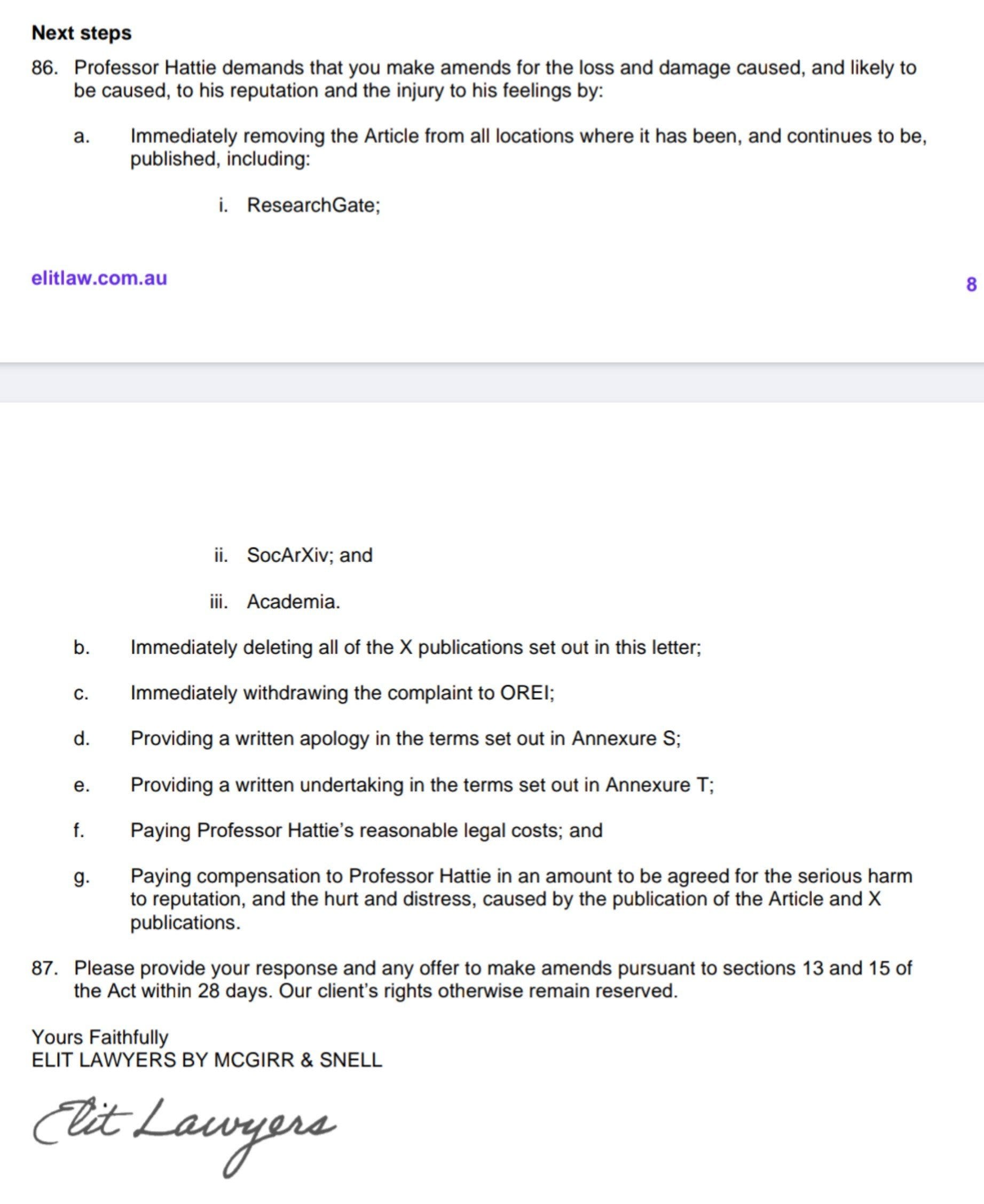
Each demand it is making of me is outrageous (I was completely in the right and they had no grounds to assert otherwise) but the truly remarkable aspect was that I drop my complaint to the university (OREI stands for the Office of Research Ethics and Integrity at the University of Melbourne. Surely, if my complaint was groundless, Hattie would have nothing to fear from any investigation by his employers?
If I am receiving this kind of baseless legal intimidation, you may assume that the University of Melbourne, Elgar, and Frontiers are receiving similar letters. As an individual, I can make the choice to simply ignore the threat on the basis that it is groundless, but these institutions may not feel the same freedom to be similarly cavalier, since legal action would be costly even if there is little chance that they would lose.
Fake reference but no retraction
This is the context behind a recent rather jaw-dropping correction in Frontiers to an article by Hattie following a complaint I made some months ago. The paper contained a number of referencing problems, including a fake reference (i.e. a hallucinated reference that is included in the paper to support a point but does not actually exist). Since even the fake reference on its own is a clear indication of AI authorship, I assumed, especially given the amount of issues I reported, that the journal would retract the paper. Clearly, the COPE guidelines would indicate that the paper should be retracted. The guidelines state that:
Editors can decide to retract a publication if they no longer have confidence in the results and conclusions reported in the paper. Reasons for this loss of confidence can be, but are not limited to:…Any form of misrepresentation, for example:…undisclosed involvement of artificial intelligence (AI).
Instead, the journal has decided to issue a very lengthy and substantive correction. The apparent reason for issuing a correction rather than a retraction is that ‘none of the corrections affect the study's data, methodology, analysis, or findings’. I can now show that the paper has more serious issues that very much do affect the study’s methodology and analysis. After providing the corrections in full, I will outline the further issues which mean that the editors can no longer have faith in the study and that it must be retracted.
Correction notice
—The correction notice in full—
‘In the published article, there were errors in several references in the literature review and in the bibliographic details of some entries in the reference list. The publisher and authors apologise for these errors. These corrections do not affect the study’s data, methodology, analysis, or findings.
1 Reference and attribution corrections in the text
1.1 Knake et al. (2021)
The reference for Knake et al. (2021) was erroneously listed as: Knake, A., Novak, E., Blanchard, S., and Tesch, B. (2021). “Digital curation in K-12 classrooms: Strategies for deeper learning.” TechTrends. 65, 89–97. doi: 10.1007/s11528-020-00541-5
This reference could not be verified. It has been removed from the reference list, and the corresponding sentence in Section 2.3 has been revised to remove the citation. The relevant point is supported by Torphy et al. (2020), which is already cited in the paper.
The original sentence in Section 2.3, paragraph 2 read:
“When materials from these sites are used to develop skills to remember or memorize facts, then learning decreases over time. However, learning is more likely to increase when they are curated to develop understanding and apply knowledge (Knake et al., 2021).”
The corrected sentence reads: “When materials from these sites are used to develop skills to remember or memorize facts, then learning decreases over time. However, learning is more likely to increase when they are curated to develop understanding and apply knowledge.”
1.2 Sahin-Taskin (2017)
The reference for Sahin-Taskin (2017) was erroneously listed as: Sahin-Taskin, C. (2017). Exploring pre-service teachers’ perceptions of lesson planning in primary education. Int. Electron. J. Elemen. Educ. 9, 599–612. doi: 10.1007/s10639-017-9576-3
The correct reference is: Sahin-Taskin, C. (2017). Exploring pre-service teachers’ perceptions of lesson planning in primary education. Journal of Education and Practice, 8(12), 57–63.
In addition, the claims attributed to Sahin-Taskin (2017) in Sections 2.1 and 2.5 extended beyond what the source directly supports. Sahin-Taskin’s study examined pre-service teachers’ perceptions of lesson planning and did not compare novice and experienced teachers.
The original sentence in Section 2.1 read:
“Sahin-Taskin (2017) provides empirical evidence that novice teachers create more detailed lesson plans, incorporating explicit instructional strategies, whereas experienced teachers modify and adapt materials more fluidly based on their classroom contexts.”
The corrected sentence reads: “Prior research suggests that novice teachers tend to create more detailed lesson plans incorporating explicit instructional strategies, whereas experienced teachers modify and adapt materials more fluidly based on their classroom contexts (Griffey and Housner, 1991; Krepf and König, 2023).”
The original sentence in Section 2.5 read:
“Teachers earlier in their careers tend to write longer, more comprehensive plans, including explicit teaching strategies, learning activities, and assessment tasks, but often have more difficulty aligning curriculum, assessment, and reporting requirements (Sahin-Taskin, 2017).”
The corrected sentence reads: “Teachers earlier in their careers tend to write longer, more comprehensive plans, including explicit teaching strategies, learning activities, and assessment tasks, but often have more difficulty aligning curriculum, assessment, and reporting requirements (Griffey and Housner, 1991; Krepf and König, 2023).”
1.3 Frank et al. (2018) and the Pinterest statistic
The statement attributing the statistic that “87% of teachers used Pinterest in lesson planning and delivery of instruction” to Frank et al. (2018) was incorrect. This figure does not originate from the Frank et al. (2018) chapter. The sentence has been revised to remove the specific percentage and to attribute the broader claim to a source that supports it.
The original sentence in Section 2.3 read:
“Given the rise and ease of access to the internet, it is thus no surprise that the greatest source of these resources is Pinterest and YouTube. Frank et al. (2018) noted 87% of teachers used Pinterest in lesson planning and delivery of instruction.”
The corrected sentence reads: “Given the rise and ease of access to the internet, online platforms such as Pinterest and YouTube have become widely used sources of teaching resources, with research showing that teachers frequently turn to such platforms for lesson planning and instructional materials (Torphy et al., 2020).”
1.4 Ball and Cohen (1996)
The paraphrase of Ball and Cohen (1996) in Section 2.1 has been revised to more precisely reflect the source’s argument.
The original sentence read:
“Ball and Cohen (1996) emphasized the potential of curriculum materials to be key agents in improving classroom instruction, arguing that well-designed materials support teachers in making instructional decisions and adapting to the needs of diverse learners.”
The corrected sentence reads: “Ball and Cohen (1996) emphasized the potential of curriculum materials to serve as key agents in improving classroom instruction, arguing that well-designed materials can support teachers’ instructional decision-making and contribute to instructional reform.”
2 Corrections to bibliographic entries in the reference list
A full audit of the reference list was conducted. In addition to the references corrected above, the following bibliographic entries contained errors that have now been corrected:
2.1 Apple and Christian-Smith
The publication year was erroneously listed as 2017. The correct year is 1991. The reference now reads: Apple, M. W., and Christian-Smith, L. K. (1991). The politics of the textbook. New York: Routledge.
2.2 Bouckaert (2018)
The page range was erroneously listed as 238–257 and the DOI was missing. The correct entry now reads: Bouckaert, M. (2018). Current perspectives on teachers as materials developers: why, what, and how? RELC J. 50(3), 439–456. doi: 10.1177/0033688218810549
2.3 Campbell (2019)
The entry was erroneously listed with DOI 10.1080/00131857.2017.1380842. The correct DOI is 10.1080/00131857.2018.1425992.
2.4 Darling-Hammond (2010)
The entry erroneously included a volume number and page range that do not apply to this monograph. The corrected entry reads: Darling-Hammond, L. (2010). The flat world and education: How America’s commitment to equity will determine our future. New York: Teachers College Press.
2.5 European commission
The publication year was erroneously listed as 2020. The correct entry now reads: European Commission (2013). Ethics for researchers: Facilitating research excellence in FP7. Luxembourg: Publications Office of the European Union.
2.6 Krepf and König (2023)
The entry was erroneously listed with DOI 10.1080/02607476.2023.2196267. The correct DOI is 10.1080/02607476.2022.2151877.
2.7 Roschelle et al.
The publication year was erroneously listed as 2010. The corrected entry now reads: Roschelle, J., Pea, R., Hoadley, C., Gordin, D., and Means, B. (2000). Changing how and what children learn in school with computer-based technologies. Futur. Child. 10, 76–101. doi: 10.2307/1602690
2.8 Siemens and Long (2011)
The entry was erroneously listed with DOI 10.1080/08923647.2011.538646. The Siemens and Long (2011) article was published in EDUCAUSE Review and does not have a DOI. The corrected entry reads: Siemens, G., and Long, P. (2011). Penetrating the fog: analytics in learning and education. EDUCAUSE Review, 46(5), 30–40.
The authors apologise for these errors and confirm that none of the corrections affect the study’s data, methodology, analysis, or findings. The original version of this article has been updated.’
—End of correction notice—
Further problems in the paper
Although Frontiers should be commended for producing a timely and extensive retraction, it is unfathomable to me that editors could recognise all these referencing errors and still have faith in the authors to accurately undertake the methods, results, and analysis. My strong sense, as described in the introduction, is that Hattie’s lawyers had a role in limiting the journal’s response to a correction, although I should acknowledge this is entirely speculative on my part.
However, the paper is so flawed that it took me five minutes reading through the Methods and Discussion sections to notice further serious referencing problems. The most serious issue is to do with the Methods. The authors provide a completely contradictory account about informed consent (this was a questionnaire study of 2,594 teachers).
In the ethics statement they report that the did not gain the informed consent of participants (I have no idea whether or not they were correct in stating it was not required):
Ethical review and approval was not required for the study on human participants in accordance with the local legislation and institutional requirements. Written informed consent from the participants was not required to participate in this study in accordance with the national legislation and the institutional requirements.
However in the methods section, in the only reference provided, the authors state that ‘The study adhered to European Commission ethics guidelines (2013)’. But in these ethics guidelines, the fourth principle is that research ‘honours the principle of informed consent…’
So, the authors in the article state they gained informed consent, while in the ethics statement indicate they did not do so. More than likely, AI wrote the methods section and so the authors were unaware of the contradiction they were forming.
In relation to failures related to the authors’ analysis, they write the following in the Discussion:
This reinforces the need for investment in digital infrastructure for collaborative resource sharing and aligns with recent policy goals on equity and professional development through digital teaching tools (European Commission, 2013).
The problem is that the reference is to the above paper that has absolutely nothing to do with resource sharing or professional development:
European Commission (2013). Ethics for researchers: Facilitating research excellence in FP7. Luxembourg: Publications Office of the European Union.
So, in addition to the array of corrections listed above, Frontiers now has to decide whether to issue further corrections or whether to retract. It goes almost without saying that the correct course of action is to retract given that the authors have provided contradictory ethics statements in addition to including a fake reference, a phantom statistic, citations that do not support the claim being made, and many further errors.
But on the other side of the scales, there is the issue of Hattie’s legal team. I hope that in publicly talking about the empty and absurd threats that Hattie’s legal team have made, that institutions such as Frontiers but also the University of Melbourne, may be encouraged to take the appropriate steps to defend academic integrity, rather than bow to the pressure of a fraud.
What is at stake?
For academia to continue to have a prominent role within society, it is imperative that the public can, on the whole, trust the knowledge that it produces. And there are clear principles and practices that are deeply entrenched within universities that enable trustworthy knowledge to be produced. However, at the same time, it is in the interests of a lot of actors within academia to bend and even break such principles and practices. Disreputable researchers can forge careers, while universities and institutions may turn a blind eye to academics and students who bring in prestige and money to the university.
It is a battle that cannot be lost, but is not being won. Cases such as Hattie, and in particular his Frontiers articles, are important because they pinpoint a high-profile situation in which this contest is being played out. On the one hand, it is imperative that journals and publishers do not produce knowledge that has been generated by AI and therefore is likely to sound plausible but be riddled with errors, short on wisdom, and offer little in the way of substantively useful knowledge. On the other hand there are powerful individuals (Hattie is influential, rich, and well-connected, and is employing a law firm to threaten those who would hold him to account) and institutions (Melbourne have chosen to turn a blind eye, to protect their own interests) who are working hard to ensure that shoddy research goes unchallenged.
More specifically, it is clear as day that the Frontiers article has absolutely no place in the scholarly literature, and this would be more than apparent to any moderately unbiased observer. If it is not removed, and if the rest of Hattie’s plagiarised and AI-authored work is not removed, then there is little hope for the forces safeguarding academic integrity to win out.
Obviously academic fraud and dishonesty is rife and most people aren't caught, but Hattie had a massive platform as the mouthpiece of the right wing neoliberals, and has essentially altered the face of education as a profession in Australia.... based on nothing more than vibes.
Given he's so keen on hiding behind lawyers, I'd wonder if a firm out there is interested in a class action suit against him for the mental health impacts and hurt feelings of hundreds of thousands of teachers and millions of children who have suffered because of his lies?
How is this any different from the "vaccines cause autism" publishing disaster, of which we are still suffering the consequences?
Assuming the journal’s story is correct: How can you write a draft with so many reference errors in the first place?
As always, glad you’re fighting the good fight.