
Five articles with fake references found in the British Educational Research Journal
They are not good papers

BERA-affiliated journals are currently publishing endless AI-written articles. I don’t believe there’s any excuse for a top journal to be publishing LLM-written articles (because they’re so bad). But there’s really a problem when a journal is publishing papers with fake references. Not because the reviewer/editor should comb through every reference, necessarily, but because it shows how little effort the papers have taken. If authors haven’t even bothered to check their own references, then the papers are likely to contain further clear and obvious issues.
Here, I show that the British Educational Research Journal (BERJ) has published five articles with multiple fake references (provided in the Appendix). For each paper, I will outline the most glaring further problem that should have been addressed prior to acceptance.
1. Ahmed et al (2025): 21 fake references
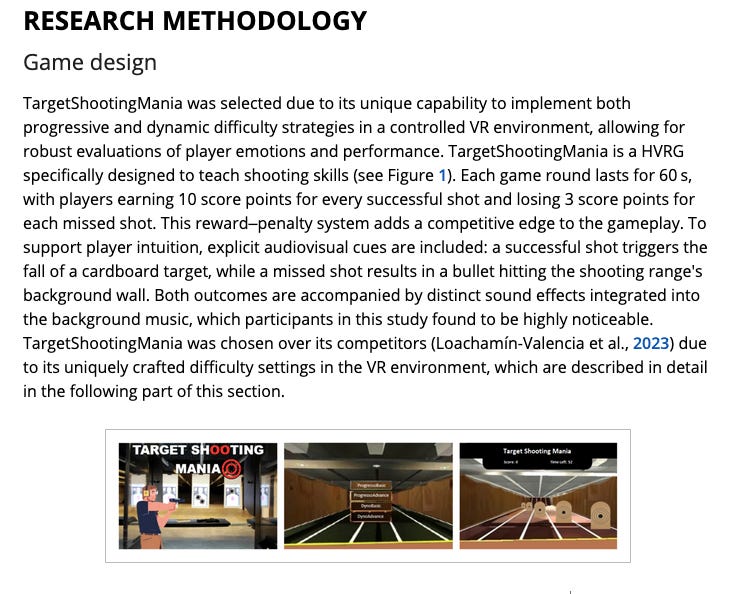
The educational game is called…TargetShootingMania. You shoot cardboard boxes. The learning outcome is …’shooting skills’ (the ‘learner’ in the title of the article is the learner of shooting cardboard boxes). Call me ‘trad’, but I really can’t see the educational angle. Occasionally the paper gestures to the relevance for educational technology but there’s nothing at all substantive. It simply doesn’t belong in a mainstream educational journal (and almost certainly not in an educational technology journal).
2. Akman Yeşilel (2025): 8 fake references
There’s a 651 word paragraph (£) summarising 6 themes providing excerpts from interviews. It’s impossible to read – clearly an LLM paragraph that’s got out of hand.


3. Cui & Liu (2025): 8 fake references
Although only secondary data is used (£), both the ethics and consent statements are written as though for primary research studies. The ethics statement says that ‘all procedures performed in studies involving human participants were in accordance with the ethical standards of the institutional and/or national research committee’, while the informed consent statement says that ‘informed consent was obtained from all individual participants included in the study’. Surely a reviewer or editor should have seen these obvious anomalies?
4. Farwa et al. (2024): 7 fake references
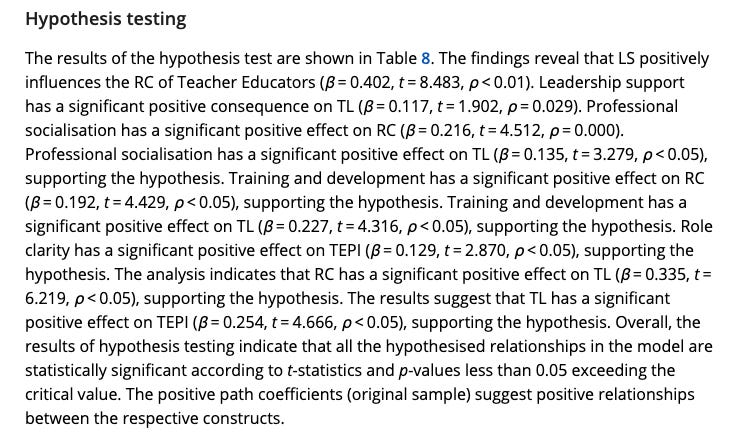
Following nine tables of data in a row (in a questionnaire study [£]) a paragraph exhaustively sets out the data we’ve already been given in one of the tables, maddeningly flitting between full terms and abbreviations. Having read through ‘supporting the hypothesis’ six times, it is slightly aggravating to then discover that in fact all the hypotheses were supported, and it was completely unnecessary to detail every one.
5. Zhou & Wang (2024): 3 fake references
In this paper (£) Figure 3 and Figure 6 are the same. For figure 3, the wrong graph has been added.


Conclusion
There is no justification to publish these articles, certainly in their current form. It’s not normal to have a 651 word paragraph, for incorrect figures to be included, for ethics statements that do not correspond to the study, or for shooting games to be considered educational. Had basic peer-review been rigorously conducted, these papers are not accepted.
That the journals affiliated with the association of education academics are routinely, and apparently heedlessly, publishing AI-written articles should be regarded as an extremely serious and unfortunate matter at a time when education academics are struggling to demonstrate their worth. Over the last 15+ years, a significant and powerful segment of the educational establishment has firmly decided that education academics are neither credible nor capable actors. It is one thing to position BERA, in turn, as a critic of ‘state-conceived educational policy’, as the President of BERA has done (£). But then, as an absolute minimum, we must be more rigorous than the state that we’re critiquing. If we allow our flagship journals to fill with AI slop (presumably pushing out excellent or at least competent work in the process) then we are making a better case for our marginalisation than any critic ever could.
Appendix
Here are the apparently fake references in the papers:


