

John Hattie was once indisputably the biggest name in education and is still incredibly influential. Over the past year I have reported that he has plagiarised extensively throughout his career, from his PhD in 1981 to an article published this year. In the process, I provided the University of Melbourne with around 200 instances of plagiarism committed by John Hattie during his time working at the university. See a recent story in Retraction Watch for more detail.
On receiving the complaint, the university had a choice to make. They could have acted with integrity, investigating the matter thoroughly, and taking the necessary disciplinary actions. Or they could have simply feigned to do a proper investigation, strategically deviating from the proper process in order to find their superstar researcher innocent of plagiarism. In this post I set out how they chose poorly.
In the investigation there were two key deviations from the proper process:
Failing to use their own definition of plagiarism
Checking only 14 instances of plagiarism (out of around 200)
If they had either used their own definition of plagiarism or checked all 200 instances of plagiarism, they would have had no choice but to find that Hattie had plagiarised.
1) Failing to use their own definition of plagiarism
The University of Melbourne, like every university, has a detailed and extensive definition of plagiarism. For the purposes of Hattie’s case, there are two aspects of the definition that matter: plagiarism by ‘copying’ and plagiarism by ‘inadequate paraphrasing’.
Of the 200 instances I provided to the university, around 150 fell under the university’s category of plagiarism by ‘inadequate paraphrasing’:
This happens when you try to explain another author's ideas in your own words, but your wording remains too close to the original text. This is poor scholarship and amounts to plagiarism.
Although limited credit is provided to the source, since the author’s work is cited, inadequate paraphrasing can still represent serious and significant plagiarism. For example, in this passage from his most famous work Visible Learning (a passage he partially replicated in the 2023 version, during his time at the University of Melbourne) Hattie makes effectively no attempt to explain in his own words, and he is plagiarising even while indirectly citing his sources:
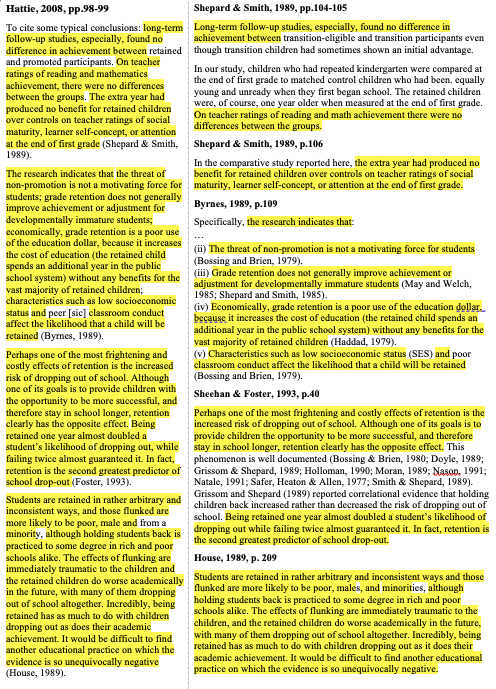
In the report the University of Melbourne did not attempt to justify not using their own definition. They merely write
The Code [Australian Code for the Responsible Conduct of Research 2018] does not define “plagiarism”, but it is ordinarily defined as “... presenting and using another’s published or unpublished work, including theories, concepts, data, source material, methodologies or findings, including graphs and images, as one’s own, without appropriate referencing and without permission when permission is required.”
I do not have access to the link they gave for the citation (it’s for the University of Melbourne employees only), but it is clearly labelled as relating to ‘funding contracts’, and the Canadian funding agency (p.3/6) uses a very similar definition in its ‘minimum’ expectations of researchers. It is clear that the general focus on theories and concepts is germane to the requirements of a funding agency (they are concerned with stealing people’s ideas) but it is not a suitably full and complete definition for a university to hold a professor to account. For that, they obviously should have used their own definition. But by using a funding agency’s definition, they were able to then claim that Hattie’s plagiarism by insufficient paraphrasing is in fact not plagiarism.
2) Checking only 14 instances of plagiarism (out of around 200)
The ruse of using a funding agency’s definition only take the university so far. I also provided the university with straight plagiarism by copying, which is plagiarism by any definition. For example:
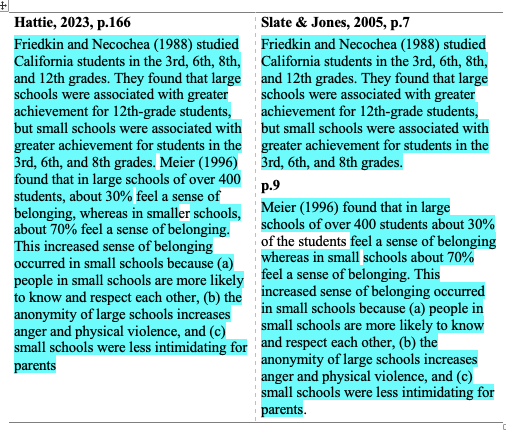
To avoid being compelled to recognise this as plagiarism, the university only looked at a ‘random sample’ of 14 instances of plagiarism out of the 200. The sample, presumably, did not involve any of the roughly 50 instances I provided of plagiarism by copying and certainly not the longer examples. There is no justification for only looking at a sample, and certainly not a ‘random’ sample. First, a sample was unnecessary: the university has its own academic integrity unit, and very clearly had the capacity to investigate all 200 instances. Second, in my correspondence with the university I very deliberately distinguished between the two types of plagiarism (by copying and insufficient paraphrasing). To simply put them in one big pot from which they took a sample means they ‘risked’ (scare quotes) only looking at plagiarism by inadequate paraphrasing, which they have already (illegitimately) defined out of existence. Third, at no stage did the university indicate that I was providing them with too much evidence for them to handle. Rather, they encouraged me to share everything I had. If I had known they were only to look at 14 instances, I would of course have provided them with the 14 most serious.
Clear and blatant corruption
To recap, by failing to use their own definition of plagiarism, and instead using a funding agency’s definition, the University of Melbourne was able to re-define roughly 150 out of 200 instances as non-plagiarism. By then looking only at a sample, the university was then able to ignore the instances of clear plagiarism by any definition. The investigation’s cynical shortcomings are clear and obvious, and I assume they only thought they could get away with it through binding me to confidentiality. However, the process was so clearly corrupt that I feel no compulsion to adhere to their expectation. We rely on universities to uphold academic integrity, and they must be held to account in this most basic and fundamental task.
Thank you so much. Hattie is a protected individual because he says what the government wants to hear (i.e. that student results are correlated, predominantly, with teacher ability, and that school funding, class sizes, or administrative support have little to do with it).
Cannot tell you how affirming this is. I’ve been looking askance at Hattie’s methodology for years.